 In the first few weeks of pregnancy most women are focusing on getting through the morning sickness and fatigue that often comes with the first trimester and tend to focus their energy on baby announcements and gender reveals. However, some of the most fundamental parts of having a positive pregnancy, birth and postpartum start with how you prepare in the first trimester so here are my top tips for choosing a form of care for your pregnancy, birth and postpartum.
1. Vision –What is truly important to you in your pregnancy, birth and postpartum? Do you want to see the same care provider throughout the entire process? Do you want to be a part of the decision making? Do you want a birth photographer? How do you see yourself giving birth? Are you wanting minimal intervention? What kind of pain relief options are you comfortable with? Are you interested in waterbirth? Do you want to receive your own baby? This really is the foundation for working out what kind of care provider you choose as some of these things will not be available or supported in certain models of care.
2. Options – There are many options of care available, both public and private. It is important to have an awareness of all the different options and what they offer. E.g., waterbirth, continuity of care, midwifery led or obstetric led care or a combination of both, and what postnatal support they offer, just to list a few. Do not assume that the most expensive option is going to get you the type of care that you want. The maternity system is a multibillion-dollar industry and medicalised birth makes a lot more money and is easier to plan than physiological birth.
3. Interview – Once you are aware of all of the models of care available, it is time to interview some different services. If you are going private, you are paying for a service that they are offering. Do not assume because they are in the birth industry that they support the type of birth that you are planning for. If you are public, consider the different hospitals around you and what options they have available. You may choose to drive a little further to a hospital that offers services that your local hospital does not offer E.g., Waterbirth or midwifery group practice programs.
 4. Ask questions about how they routinely support pregnancy and birth before telling them your plans for birth. If you know what is normal for them, you will know that they are naturally aligned with the type of birth you are planning. Ideally you want a care provider that has the same vision for birth as you do, you do not want to advocate for yourself if you do not need to. Consider asking how many women they book per month and what their induction and caesarean section rate are. If they seem uncomfortable answering these questions, then consider why? As the potential client paying for a service, you are within your rights to ask these questions to decide if they are the best fit for you.
5. Listen to the language that is used and how they see birth. Do they make birth sound like a normal physiological function of the body that has been happening for thousands of years or like something that needs to be managed and controlled by them? Do they make you feel like you are in control of making the decisions or telling you what you must do?
6. Listen to your intuition and choose a care provider that feels most aligned with your vision. Are there ANY red flags going off in your brain? Often these red flags happen early and start small but women choose to ignore them and see the good in the care provider. Those red flags usually become stronger as the pregnancy goes on and rarely go away. 
If this seems overwhelming and you need a little help working through this and getting clear on your vision for birth, that is ok! Book a Pregnancy Planning call with me and let me help you consider all of your options.
The Positive Birth Program is everything you wished the hospital birth classes were.
In many ways, The Positive Birth Program is an active birth class designed for all families with everything you think will be covered in a Hospital Birth Class but usually isn’t. Hospital based birth classes tend to be less about active ways to manage your labour and pain and more about pharmaceutical pain relief options and potential interventions that may occur.

ACTIVE BIRTH is not new. It is simply a way of describing how women the world over have always behaved during labour and birth throughout history —
Janet Balaskas
The focus of active birth classes is to prepare you and your birth partner mentally and physically for birth, so you have a deeper understanding of how to manage your labour through breathing techniques, movement and relaxation tools.
The Positive Birth program teaches you a mixture of techniques you can use yourself and hands-on techniques that your birthing partner can perform like massage and acupressure to minimise the pain and amount of time spent in active labour.
Involving your partner in the classes also gives your birthing partner a clear role of how they can support you and helps to build confidence for your birthing day.
Using these active birthing techniques in the lead up to birth helps soften the ligaments around your pelvic floor as the body grows and stretches and the centre of gravity changes.
If you are looking after your body in the lead up to birth using these active techniques it helps your baby move down into an optimal position for birth.
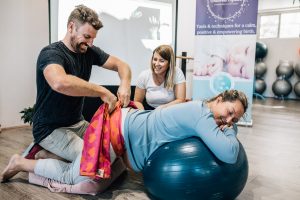
Learn to tune into your natural instincts
If you are attending an active birth class it is far more likely you will have an active birth. We constantly see women giving birth in movies where they lay on their backs, adding to the fact we don’t get to witness other women in our lives and society give birth so our intuition to listen to our body and move how we want to move has been suppressed.
Rather than laying on your back (we are not designed to birth on our backs) you are choosing to move your body and use different positions during labour and birthing. This means tuning into your natural instincts and doing what feels right. These movements can be entirely spontaneous, or they may be movements you have learnt and practiced in your active birth class.
There are lots of benefits to an active birth such as being in an upright position which works with gravity to help your baby descend, which also means that labour may be shorter and less intervention needed. The movements can also feel good if you are in discomfort.

Your birthing partner plays a big role, so get them prepared
Feeling safe and supported during labour is vital to how your nervous system responds. The hospital midwife will not be there for every contraction you have. They have other women to support and have paperwork, blood pressure, baby monitoring and other tasks to get through. Your emotional support comes from your own birthing partner and the preparation you do for the big day.
So if having an active birth is important to you and you are aiming for minimum intervention learning these active birth techniques through The Positive Birth Program will set you up for a positive birthing experience. You’ll walk into your birth day having a toolkit and feeling confident in bringing your baby into this world.
Click here and come join a group class in 2023.
Coached pushing is all too common in hospitals. It definitely happened to me with my first baby. I had done Hypnobirthing and had heard of ‘Coached pushing’ but never thought the private obstetrician I had chosen would do it to me. He knew I wanted an uninterrupted physiological birth. I had a vaginal exam done and I was told by my obstetrician that I was 10cm and could start ‘pushing’ and he would be back in 1 hour and he left the room.
I had no urge to push and struggled to know where exactly I should be pushing? I told the midwife I wanted to wait for the urge and breath my baby out. She said we could ‘try that’ but the obstetrician would be back in 1 hour and he would want to see progress. I was shocked but tired and vulnerable. I followed their instruction and pushed for 1 hour and 20 minutes.

I wish I had of followed my body’s lead. But I was lucky that I was so stubborn and pushed with everything I had on my own without intervention. When that urge finally came in the last 20 minutes it felt so much better, all my practice on ‘bearing down’ now felt effective.
Did I just waste energy where I didn’t need to? Absolutely! I also popped all the blood vessels in my face from pushing so hard. It completely unnatural pushing on demand. Imagine someone yelling at you to poo when you didn’t need to poo!
When it comes to this phase of birth there is so much pressure on time. Hospitals start pressuring for instrumental delivery once a woman has been pushing for an hour or two. Often commenting that mum and baby are becoming tired or distressed.
But what if we waited for the bear down instead, rather than prompting a woman to push involuntarily just because she is 10cms dilated? Just because you are fully dilated it does not mean the body is instantly ready to push, the contractions are not just opening the cervix but pushing the baby down further into the pelvis.
Avoiding cervical examinations is a great way to avoid coached pushing! It is also time to use your voice and stop them in their tracks if they start coach pushing!
If you would like to learn more about breathing and bearing down naturally and birthing on your own terms, click here to book into one of my upcoming classes in 2023

One of the most common questions I get asked is about when to do hypnobirthing classes.
As a certified Hypnobirthing Practitioner, I believe there is no “one size fits all” approach – it really is a personal preference, and it depends on a few different things, such as:
How are you feeling about your birth?
Are you an anxious person? Does the thought of giving birth trigger anxiety for you? If so, I would suggest booking into a class early in your pregnancy. Pregnancy is a time to be enjoyed and when you understand birth, what your options are and how to manage the intensity of labour, it reduces the anxiety. Plus you will leave the program with lots of mindfulness techniques to practice regularly in the lead up to birth to help rewire the neural pathways in your brain to see birth as a positive and empowering process, not something to be feared.
What is your personality type?
Are you the type of person to dive straight into practicing techniques, listening to the downloads and fully immersing yourself in the new things that you have learnt? If so then starting early will be perfect for you too.
If you are the type of person that will do the hypnobirthing classes and struggle to make the time to practice the techniques and probably won’t actively start practicing until you finish work and get closer to the big day, than I would suggest waiting until closer to 30 weeks pregnant to start the hypnobirthing program.
Are there potential complications coming up in your pregnancy?
Often mums will hold off booking in for a class if they have potential complications in their pregnancy. However, as a hypnobirthing practitioner I truly believe that if there are potential complications than it is better to do the program earlier than later. Regardless of if you have a vaginal birth, induction or a cesarean, this program will give you the skills and confidence to navigate any complications.
When there are potential complications or the need for medical intervention, it is important to come from a place of being fully informed, knowing what your options are and knowing what questions to ask your care provider to make decisions that feel best for you and your baby. This is called ‘informed consent’ and it is a subject I’m passionate about as informed consent is the law but something that isn’t educated well in hospital programs. When women are labelled with a potential complication it can often come down to policy and procedure and not the woman’s personal situation. Just because there is a policy in place, it doesn’t mean that it is right for you and your baby, only you get to choose what you feel most comfortable with and this program will give you the skills to advocate for yourself and your baby.
If your question isn’t here, feel free to email me with any questions you may have.
Now that you have your questions answered, is it time to book your spot in a Hypnobirthing Class? Classes often book out 1 to 2 months in advance so make sure you book ahead.
Head to our Hypnobirthing Classes page to find a date.